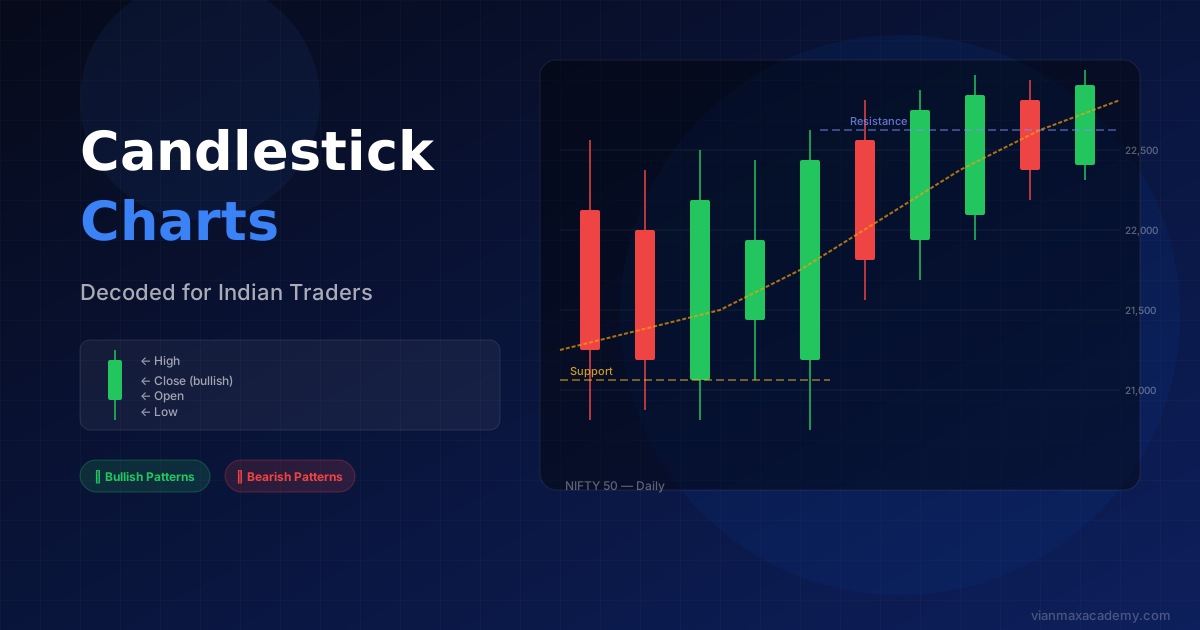
Candlestick charts are the language of the market. Every professional trader — from a floor trader in Mumbai to an algo quant in Bengaluru — uses candlestick charts as their primary tool. The good news: once you understand how to read them, the market starts talking to you.
This guide is written specifically for Indian traders learning to analyse NSE and BSE stocks. Every example and pattern here is directly applicable to your Nifty, BankNifty, or equity charts.
What is a Candlestick Chart?
A candlestick chart shows price movement over time. Each individual "candle" represents one time period — this could be 1 minute, 15 minutes, 1 hour, or 1 day, depending on your chart setting. Each candle tells you four pieces of information about that period: the Open, High, Low, and Close price (collectively called OHLC).
Candlestick charts originated in Japan in the 18th century and were used by rice traders before the concept of modern financial markets even existed. They were introduced to Western trading by Steve Nison in the 1990s and are now the global standard for technical analysis.
Anatomy of a Candle
Every candle has three parts:
- The Body — the thick rectangle between the Open and Close price. This is the most important part of the candle.
- The Upper Wick (Shadow) — the thin line above the body, showing how high the price reached during that period before pulling back
- The Lower Wick (Shadow) — the thin line below the body, showing how low the price dropped before recovering
Colour tells you direction:
- Green (or White) candle — Close price is HIGHER than Open price. Buyers were in control. This is a bullish candle.
- Red (or Black) candle — Close price is LOWER than Open price. Sellers were in control. This is a bearish candle.
Quick memory trick: Green = Greed (buyers pushed price up). Red = Retreat (sellers pushed price down).
Bullish Candlestick Patterns
These patterns signal that buyers are gaining strength and the price may move up.
1. Hammer
A small body at the top with a very long lower wick (at least 2x the body length) and little to no upper wick. Appears at the bottom of a downtrend. It means the market sold off sharply during that period but buyers stepped in aggressively and pushed the price back up. On NSE: frequently seen on Nifty 50 intraday charts at key support zones.
2. Bullish Engulfing
A small red candle followed by a large green candle that completely "engulfs" the previous candle's body. This is one of the strongest reversal signals. The buyers overwhelmed the sellers completely. Look for this pattern after a 3–5 day decline in any NSE stock or index.
3. Morning Star
A three-candle pattern: large red candle → small indecisive candle (Doji or spinning top) → large green candle. The small middle candle represents uncertainty; the following green candle confirms buyers have taken over. Highly reliable on daily charts for Indian stocks.
Bearish Candlestick Patterns
These patterns signal that sellers are gaining strength and price may move down.
1. Shooting Star
A small body at the bottom with a very long upper wick. The opposite of a Hammer — appears at the top of an uptrend. Buyers pushed price up sharply but sellers overpowered them by the close. A warning sign that the uptrend may reverse.
2. Bearish Engulfing
A small green candle followed by a large red candle that engulfs the previous candle's body. Strong reversal signal at market tops. If you see this after a strong 5-day rally in a Nifty midcap stock, treat it as a sell signal.
3. Evening Star
The bearish equivalent of the Morning Star: large green candle → small indecisive candle → large red candle. One of the most reliable three-candle reversal patterns at market tops.
Neutral and Reversal Patterns
Doji
A candle where the Open and Close are almost the same price, creating a very tiny body with wicks on both sides. A Doji represents indecision — neither buyers nor sellers dominated. Alone it's neutral, but a Doji after a strong trend is a warning that the trend may be about to reverse.
Spinning Top
Small body with roughly equal upper and lower wicks. Similar to Doji — signals indecision and a potential pause or reversal in the current trend.
Combining Patterns with Support and Resistance
This is where candlestick reading becomes truly powerful. A Hammer pattern is a much stronger signal when it forms exactly at a known support level. A Shooting Star at a known resistance level is a high-probability sell signal.
The rule most professional Indian traders follow: Never trade a candlestick pattern in isolation. Always combine with at least one other confirmation — support/resistance, volume, or a moving average.
✅ Pro Tip: On NSE, the most reliable support and resistance levels are psychological round numbers (e.g., Nifty 22,000, 22,500), 52-week highs/lows, and previous swing highs/lows on the daily chart.
Common Beginner Mistakes
- Trading every candle pattern they see — only trade patterns that form at significant price levels
- Ignoring volume — a Bullish Engulfing with 3x average volume is far more reliable than one with below-average volume
- Using too small a time frame — 1-minute candles generate too many false signals; start with 15-minute or daily charts
- Forgetting the bigger trend — a Hammer in a strong downtrend is less reliable than one at a major weekly support level
How to Practice
The fastest way to learn candlestick charts is to review historical charts every day. Here's a simple 30-day routine:
- Open TradingView and load a Nifty 50 daily chart
- Scroll back 6 months and mark all the patterns you've learned
- Check what happened after each pattern — did it work or fail?
- Keep a journal of patterns and outcomes
- After 30 days, you'll have a gut-level understanding that no theory course can give you
🎓 Take it further: Vianmax Academy's Advanced Technical Analysis course in Anna Nagar, Chennai covers 40+ candlestick and chart patterns with live NSE/BSE trade setups and mentored practice sessions.
Frequently Asked Questions
Still have questions? Here are the most common ones we hear from students and traders at Vianmax Academy.
What is a candlestick chart and how is it read?
A candlestick chart displays four prices for each time period: Open, High, Low, and Close (OHLC). Each 'candle' has a body (the range between open and close) and wicks (the high and low extremes). A green/white candle means the price closed higher than it opened (bullish); a red/black candle means it closed lower (bearish).
What are the most reliable candlestick patterns for Indian traders?
For Indian markets like NSE and BSE, the most reliable patterns are: Hammer (bullish reversal at support), Bullish Engulfing (strong buying signal), Shooting Star (bearish reversal at resistance), Bearish Engulfing (strong selling signal), and Doji (market indecision, often signals reversal when confirmed).
Do candlestick patterns work on Nifty 50 and BankNifty charts?
Yes. Candlestick patterns are widely used by traders on Nifty 50, BankNifty, and individual NSE/BSE stocks. They are most effective on daily and weekly timeframes, and become even more powerful when combined with volume analysis and key support/resistance levels.
How long does it take to learn candlestick chart reading?
With focused practice, you can learn the 10 most common patterns in 2–4 weeks. The real skill comes from applying patterns in live markets. Using TradingView with NSE data to review historical charts daily for 30 minutes will accelerate your learning significantly.
Should I use candlestick patterns alone for trading decisions?
No. Candlestick patterns should always be used in combination with other confirmation tools — support and resistance levels, volume, moving averages, and market context (trend direction). Relying on a single pattern without confirmation leads to false signals and losses.