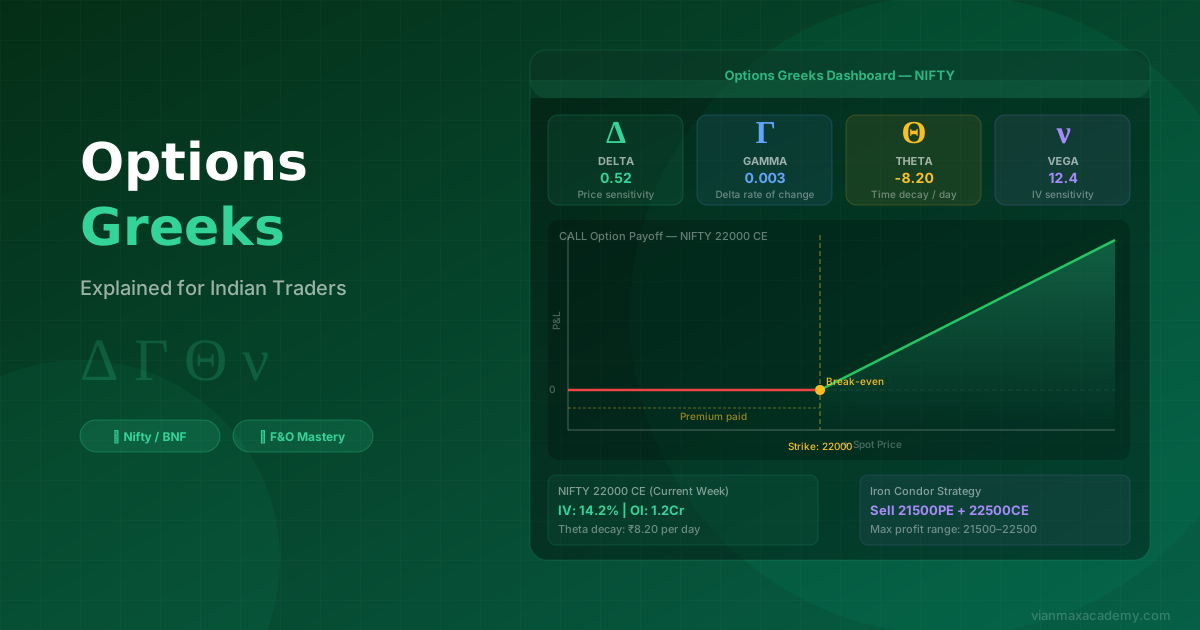
You've bought a Nifty call option. The index moved up 100 points in your favour — but your option barely moved. Frustrating, right? This is exactly the kind of situation that Greeks explain.
Options Greeks are a set of measures that tell you how sensitive your option's price is to different market forces. Understanding them is the difference between guessing in F&O markets and making informed, high-probability trades. This guide explains all four main Greeks in plain English, with Nifty and BankNifty examples.
Why Greeks Matter for Indian F&O Traders
NSE is the world's largest derivatives exchange by volume. Millions of Nifty and BankNifty options contracts are traded every day. Most retail traders who lose money in F&O do so not because they predicted the direction wrong, but because they didn't understand how time decay and volatility were working against their position. Greeks solve this problem.
Delta — How Much Does Your Option Move?
Delta measures how much your option's price changes for every ₹1 (or 1 point) move in the underlying asset.
- Call options have a Delta between 0 and +1
- Put options have a Delta between -1 and 0
Real Example: You hold a Nifty 22,000 CE (Call option). Its Delta is 0.50. If Nifty moves up by 100 points, your call option price increases by approximately 50 points (₹50 × lot size of 50 = ₹2,500 profit per lot).
What Delta tells you in practice
- Deep ITM (In The Money) options have Delta close to 1 — they move almost like the underlying
- ATM (At The Money) options have Delta around 0.50 — they move at half the rate
- Deep OTM (Out of The Money) options have Delta close to 0 — they barely move even if the index moves
Key Insight: When you buy an OTM option hoping for a big move, you're fighting low Delta. The index may move 200 points and your option barely profits — this is why many beginners are confused by their F&O P&L.
Gamma — How Quickly Does Delta Change?
Gamma measures the rate of change of Delta. It tells you how much Delta will change if the underlying moves by 1 point.
Example: Your Nifty ATM call has Delta 0.50 and Gamma 0.003. If Nifty moves up 100 points, your Delta becomes 0.50 + (0.003 × 100) = 0.80. Your option now moves much faster than before.
What Gamma tells you in practice
- ATM options have the highest Gamma — this is where the most explosive movement happens
- Gamma increases dramatically near expiry — this is why weekly Nifty options can move 200–300% on expiry day
- Option sellers hate high Gamma — it means their short position can move against them very quickly
⚠️ Expiry Day Warning: On Nifty and BankNifty weekly expiry days, Gamma is at its peak for ATM options. Positions can swing wildly in minutes. Beginners should avoid holding naked options through expiry.
Theta — Time is Working Against You
Theta is the most important Greek for options buyers to understand — and it's the one most beginners ignore. Theta measures how much value your option loses every day, purely due to the passage of time (even if the market doesn't move at all).
Example: You buy a Nifty ATM call with 7 days to expiry. Its Theta is -15. Every single day that passes, your option loses ₹15 in value × 50 (lot size) = ₹750 per day, even if Nifty doesn't move.
The Theta Decay Curve
Time decay is not linear. An option loses very little value in its first few weeks of life. But in the last 7–10 days before expiry, theta decay accelerates dramatically. This is why buying weekly ATM options at Wednesday open and holding to Thursday (expiry) is a very risky strategy — you're fighting aggressive theta decay.
Theta favours sellers
This is why option selling (writing covered calls, selling spreads) is such a popular strategy in India. Time works in your favour when you sell options — every day that passes, you keep a little more of the premium you collected.
Vega — How Volatility Affects Your Position
Vega measures how much your option's price changes for every 1% change in Implied Volatility (IV). IV is essentially the market's expectation of future price movement.
Example: Your Nifty option has Vega of 20 and current IV is 14%. If IV jumps to 16% (perhaps due to a surprise RBI announcement), your option gains 2 × 20 = 40 points in value, even if Nifty itself doesn't move.
When Vega matters in Indian markets
- Before major events — Budget Day, RBI policy, election results — IV spikes sharply, making options more expensive. Buying options before these events means paying a high Vega premium
- After major events — IV typically collapses (called "IV Crush"). If you bought an option before the event and the index moved in your favour but IV crashed, you may still lose money
- India VIX — monitor the India VIX index on NSE. High VIX = high IV = expensive options = favour option sellers
✅ Strategy Tip: Before buying options around Budget or election results, check India VIX. If VIX is already very high (above 18–20), you are buying expensive options. IV crush after the event could wipe your premium even if you called the direction correctly.
Using All Greeks Together — A Real Example
Let's say Nifty is at 22,500. You're considering buying the 22,600 CE (Out of The Money call) expiring in 5 days.
- Delta: 0.35 — for every 100 point Nifty move, your option gains ~35 points
- Gamma: 0.004 — Delta will accelerate if you're right, which is good
- Theta: -18 — you lose ₹18 per day × 50 lots = ₹900 per day even if market doesn't move
- Vega: 12 — if IV drops 2%, your option loses 24 points in value
Assessment: With 5 days to expiry, you need Nifty to move quickly and significantly to overcome the Theta and Vega drag. This is a high-risk, high-reward trade — not suitable as a "safe" buy-and-hold position.
Greeks for Common Indian F&O Strategies
- Bull Call Spread — positive Delta, limited Gamma, lower Theta drag than naked calls, lower Vega exposure
- Short Straddle — zero Delta (market-neutral), negative Gamma (risky), positive Theta (earns daily), negative Vega (prefers stable IV)
- Iron Condor — low Delta, negative Gamma, positive Theta, negative Vega — a popular range-bound strategy for Nifty monthly expiry
Common Mistakes Indian Traders Make with Greeks
- Ignoring Theta when buying weekly options — the most common and costly mistake in Indian F&O trading
- Buying options before high-IV events without checking VIX — leads to losses even when direction is correct (IV crush)
- Not adjusting Delta after a big move — professional traders Delta-hedge their positions; beginners often just hold and hope
- Treating Greeks as static numbers — all Greeks change continuously as the market moves and time passes
🎓 Take it further: Vianmax Academy's Indian F&O Mastery course in Anna Nagar, Chennai covers all four Greeks in depth, options pricing models (Black-Scholes for Indian markets), and live strategy building for Nifty and BankNifty with real trade examples.
Frequently Asked Questions
Still have questions? Here are the most common ones we hear from students and traders at Vianmax Academy.
What are options Greeks and why are they important for Indian traders?
Options Greeks are mathematical measures that describe how an option's price changes in response to various factors. Delta measures sensitivity to the underlying price, Gamma tracks how fast Delta changes, Theta measures time decay (how much value the option loses each day), and Vega measures sensitivity to implied volatility. Understanding Greeks is essential for Nifty and BankNifty F&O traders to manage risk and choose the right strategy.
What does Delta of 0.5 mean for a Nifty options position?
A Delta of 0.5 means your option will move approximately ₹0.50 for every ₹1 move in the Nifty index. An at-the-money (ATM) option typically has a Delta near 0.5. In-the-money (ITM) options have Delta closer to 1, while out-of-the-money (OTM) options have Delta closer to 0. Delta also represents the approximate probability that the option will expire in-the-money.
How does Theta decay affect Nifty weekly options?
Theta is the biggest concern for buyers of weekly Nifty and BankNifty options. Because weekly expiry contracts have very little time remaining, Theta decay is extremely fast — especially in the last 2–3 days before expiry. An ATM Nifty option might lose ₹15–30 in time value each day near expiry. This is why many experienced traders prefer to sell options (collect Theta) rather than buy them near expiry.
What is IV crush and how does Vega affect options after events?
IV crush happens when implied volatility (IV) drops sharply after an anticipated event — like RBI policy announcements, Budget day, or quarterly results. Since Vega measures sensitivity to IV, options with high Vega lose significant value when IV collapses even if the underlying moves in your favour. This is why buying options before major events is risky — the IV crush can more than offset your directional gains.
Which options strategies use Greeks most effectively in Indian markets?
Common Greek-aware strategies in Indian F&O include: Iron Condor (benefits from low Vega and high Theta — selling both sides within a range), Short Straddle (maximum Theta collection at ATM strike), Bull/Bear Spread (controlled Delta exposure with limited risk), and Calendar Spread (buying and selling different expiry contracts to profit from Theta differential). Understanding all four Greeks is crucial for managing these positions.