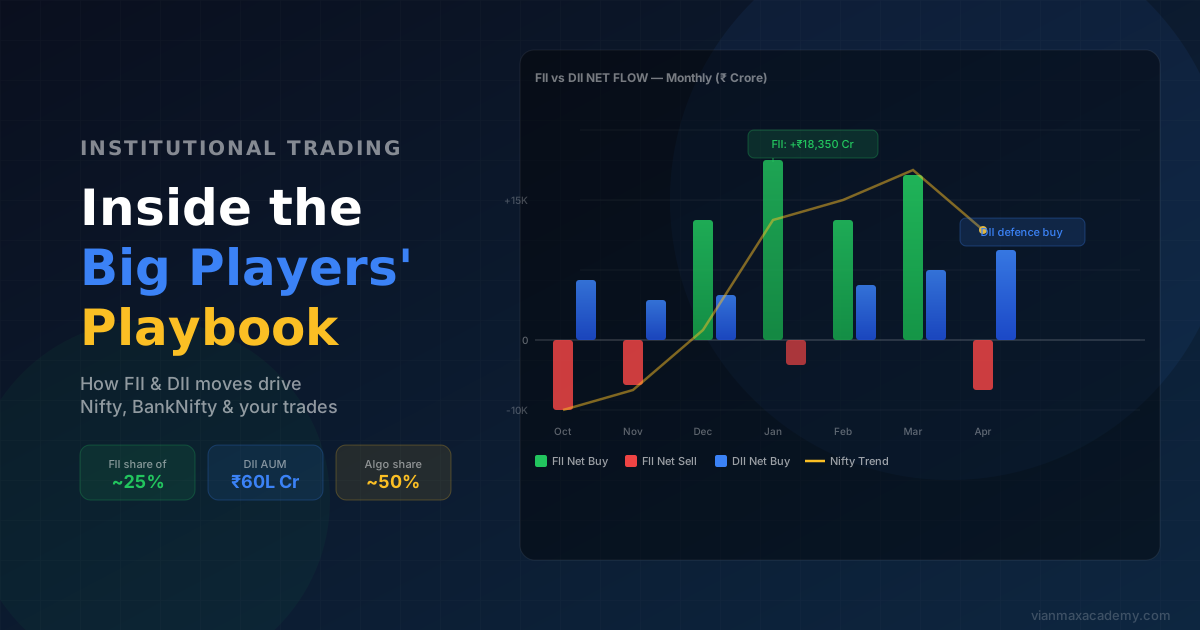
Every time you watch Nifty gap up 150 points at 9:15 AM — or see BankNifty crash 400 points in ten minutes despite no obvious news — you are watching institutional traders at work. These are not retail investors reacting to a headline. These are Foreign Institutional Investors (FIIs), domestic mutual funds, insurance companies, and algorithmic desks executing strategies that were decided hours, days, or even weeks earlier.
Understanding how institutional money moves the Indian stock market today is the single biggest edge a retail trader can develop. This article breaks down exactly how the big players operate — and more importantly, how you can read their footprints and trade smarter.
Key stat: Foreign and domestic institutions together account for over 50% of NSE cash market volume on a typical day. On high-conviction days, that share can exceed 70%. When they move, the market follows.
Who Are the Institutional Players?
Before diving into strategy, you need to know the cast of characters. Each has a different mandate, time horizon, and preferred instrument — and those differences create predictable patterns you can trade.
| Player | Type | Typical Instrument | Time Horizon |
|---|---|---|---|
| FIIs / FPIs | Foreign | Large-cap cash + F&O | Weeks to months |
| Mutual Funds | Domestic | Large & mid-cap cash | Months to years |
| LIC / Insurance | Domestic | Large-cap cash, ETFs | Years (crisis buyers) |
| Algo / HFT Desks | Both | F&O, index futures | Milliseconds to minutes |
| Hedge Funds | Foreign | Derivatives, pairs | Days to weeks |
The most important distinction for retail traders is this: FIIs drive direction, DIIs (domestic institutions) provide support. When FIIs sell aggressively, DIIs — especially mutual funds receiving monthly SIP inflows — often become the buyers who prevent a full market collapse. This FII–DII tug of war is the most reliable macro signal for any serious Nifty analysis.
Reading the FII–DII Data Every Day
NSE and BSE publish provisional FII and DII net buy/sell data every evening after market close. This single data point is the pulse of the Indian stock market today, and yet most retail traders ignore it entirely.
How to interpret the daily data
Chart Read: FII vs DII Net Flow vs Nifty (Jan–Apr 2026)
Source: NSE India provisional dataIn the chart above, notice the pattern from January to March: FII net buying (green bars rising above the zero line) coincided directly with Nifty's upward trend (yellow line). In January, when FIIs pumped ₹18,350 crore net into Indian equities, Nifty rallied over 6% in the same month.
In April, when FIIs turned net sellers, DIIs stepped in aggressively (tall blue bars) — this is the classic "DII support zone" retail traders should watch. When DII buying exceeds FII selling in rupee terms, the market typically stabilises and bounces. This is exactly the kind of reading that sharpens your intraday trading strategy for the following session.
The three FII/DII scenarios to watch
- Both FII + DII net buyers — Strongly bullish. Nifty tends to grind higher with low volatility. Add longs, reduce hedges.
- FII selling, DII buying — Tug of war. Market stays rangebound. Best suited for BankNifty strategy involving short straddles or iron condors.
- Both net sellers — Rare but extremely bearish. Nifty can fall 1–2% in a single session. Do not hold naked longs overnight in this scenario.
Actionable Insight
Check NSE's FII/DII data every evening at 7:00–7:30 PM and form your market bias for the next session before you look at any news headline. The number tells you what the smart money is actually doing — not what they are saying.
Institutional Footprints in Nifty Charts
Institutions cannot buy or sell without leaving traces in price action. A mutual fund adding ₹500 crore to an index position cannot do it quietly — the volume and price impact are always visible if you know where to look. This is the foundation of serious Nifty analysis.
1. Volume spikes at round numbers
Institutions place large orders at psychologically round levels — 22,000, 22,500, 23,000 on Nifty. When you see a massive volume candle forming near these levels on a daily chart, it is almost always institutional accumulation or distribution. A volume spike 3–4× the 20-day average at a support level is one of the most reliable institutional buy signals.
2. VWAP as the institutional benchmark
Every institutional algo desk uses Volume Weighted Average Price (VWAP) as its execution benchmark. This is why, on a typical trending day, Nifty tends to pull back to VWAP (visible on 5-minute charts) before continuing its trend. Trading bounces from VWAP in the direction of the morning gap is one of the cleanest institutional-flow intraday setups available.
3. Open Interest (OI) changes in F&O
The NSE F&O OI dashboard is a live window into institutional positioning. Here is the key logic:
- Rising OI + rising price — Fresh long positions being added. Bulls are in control.
- Rising OI + falling price — Fresh short positions being added. Bears are in control.
- Falling OI + rising price — Short covering. Rally may be temporary, not conviction buying.
- Falling OI + falling price — Long unwinding. Trend weakening, prepare for reversal.
Chart Read: Nifty OI Build-up at 22,000 Strike — March 2026
NSE F&O Data — Weekly ExpiryIn March 2026, the 22,000 CE strike on Nifty saw its OI jump from 12 lakh contracts to 28 lakh contracts over three sessions while Nifty was trading at 21,800. This massive call writing was institutional — hedge funds and prop desks selling the 22,000 strike as resistance. Nifty respected that level for four consecutive sessions before eventually breaking out.
What retail traders could do: Recognise the 22,000 level as a ceiling, avoid buying calls above it, and instead sell put spreads below 21,700 as long as OI at the 22,000 CE remained elevated. This is how OI-based BankNifty strategy and Nifty positioning works in practice.
Why BankNifty is the Institutional Favourite
If Nifty is the heartbeat of the Indian stock market, BankNifty is the pulse. Banking stocks — HDFC Bank, ICICI Bank, Kotak, SBI, Axis — collectively form about 36% of Nifty's weight. Institutions that want large, liquid exposure to Indian equities almost always go through banking stocks first.
This creates a powerful dynamic for retail traders: FII activity shows up in BankNifty before it shows up in the broader Nifty. When you see BankNifty leading Nifty by 50–80 bps at the open, it is a reliable signal that FIIs are active buyers (or sellers) in the banking space.
The BankNifty gap theory
FIIs typically execute large banking stock orders in the US/European night session through ADR (American Depositary Receipt) markets and overseas derivative markets. By the time the Indian market opens at 9:15 AM, their intent is already priced into HDFC Bank and ICICI Bank ADRs. This explains why BankNifty gaps are often more accurate predictors of the day's trend than even SGX Nifty (now GIFT Nifty).
BankNifty Strategy — Institutional Gap Rule
- If BankNifty gaps up >0.5% AND holds above the gap level for the first 15 minutes → Institutional buying confirmed. Look for long entries on the first VWAP pullback.
- If BankNifty gaps up but fills the gap within 30 minutes → Retail euphoria, institutions distributing. Avoid longs. Consider short setups at VWAP resistance.
- If BankNifty gaps down >0.5% AND DII data from the previous evening was strongly positive → High probability bounce trade. Institutions will buy the dip.
How Algo Trading India Works at the Institutional Level
When people talk about algo trading India, they often imagine complex AI systems. The reality is more practical: institutional algos are primarily execution tools designed to reduce market impact, not magical prediction engines.
SEBI data shows that algo trading accounts for approximately 50–55% of NSE cash market volume. On derivative segments, that share is even higher. Here is how institutions use algorithms in practice:
VWAP / TWAP Execution
A fund wanting to buy ₹2,000 crore of HDFC Bank cannot place a single order — it would move the price massively against itself. Instead, it uses VWAP algorithms to slice the order into hundreds of small trades spread throughout the day, buying slightly below the prevailing VWAP and never buying above it. This is why HDFC Bank often trades in a tight band around its VWAP on heavy institutional days.
Statistical Arbitrage
Hedge fund algos constantly monitor the spread between Nifty futures and Nifty spot (the basis). When the basis widens beyond its fair value — say to +20 points when the fair value is +5 — they sell futures and buy the basket of Nifty stocks simultaneously. This arbitrage keeps Nifty futures honest and creates the characteristic mean-reversion patterns you see in index futures throughout the day.
Options Market Making
Institutions run options market making algos that continuously quote buy and sell prices on Nifty and BankNifty options. These algos delta-hedge their exposure in the futures market, which is why you see automatic futures selling whenever Nifty option calls are heavily bought. Understanding this hedging flow is essential for any serious options trader.
Chart Read: Algo Footprint on Nifty 5-Minute Chart
Typical high-volume institutional sessionOn a 5-minute Nifty chart, institutional algo activity creates a distinctive pattern: three high-activity windows — 9:15–10:00 AM (opening auction and early positioning), 12:00–12:30 PM (global market open crossover), and 2:30–3:30 PM (close-of-day rebalancing and futures roll-over). Volume in these windows is typically 40–60% higher than the quiet midday period.
What this means for your intraday trading strategy: The best directional trades happen in the first and last windows. The 11:30 AM–1:30 PM window is often choppy, low-conviction, and dangerous for directional positions. Many professional traders simply stay flat or use range strategies during this period.
Block Deals and Bulk Deals — The Clearest Signal
Block deals are the single most transparent institutional signal in the Indian stock market. A block deal is a trade of at least 5 lakh shares or ₹10 crore executed in a separate window between 8:45–9:00 AM and 2:05–2:20 PM. When a block deal happens, NSE publishes it within minutes — including the name of the buyer and seller.
How to use block deal data in your intraday trading strategy
If a block deal shows a large mutual fund buying a stock at ₹850 before the market opens and the stock is currently trading at ₹845, that ₹850 block deal price becomes a support magnet for the day. Institutions that bought at ₹850 will defend that level aggressively. This creates a high-probability intraday trade: buy near ₹845–848 with a stop below ₹840, targeting ₹855–860.
Warning: Not all block deals are bullish. A large block deal where a promoter or PE fund is the seller at a discount to market price is bearish. Always identify who is selling, not just that a block deal happened.
Put–Call Ratio — The Institutional Sentiment Gauge
The Put–Call Ratio (PCR) is one of the most powerful tools for reading institutional sentiment in the options market, and it directly feeds into your BankNifty strategy and broader Nifty analysis.
PCR = Total Put OI ÷ Total Call OI
- PCR above 1.2 — Excessive put buying / call writing. Market is bearish-leaning. Contrarian signal: institutions may be setting up for a rally.
- PCR between 0.9–1.2 — Neutral, well-balanced. Market likely rangebound.
- PCR below 0.7 — Excessive call buying / put writing. Complacency. Often precedes a sharp correction as institutions unwind long positions.
Real Example — Budget Day 2026
The week before Budget day 2026, Nifty's PCR dropped to 0.65 — the lowest in six months. Retail traders were buying calls heavily, expecting a rally on Budget announcements. Institutions, recognising this one-sided positioning, were selling those calls aggressively. On Budget day itself, Nifty opened flat and then sold off 1.8%, wiping out the overpriced calls. The PCR had warned institutional players well in advance.
Building Your Institutional-Flow Intraday Trading Strategy
Now that you understand the signals, here is a practical intraday trading strategy framework that trades with institutional flow rather than against it.
The 3-Step Institutional Alignment Framework
Pre-Market: Establish the Bias (8:30–9:10 AM)
Check yesterday evening's FII/DII data. Check GIFT Nifty (formerly SGX Nifty) direction. Check BankNifty ADR performance (HDFC Bank, ICICI Bank US-listed instruments). Form a clear directional bias — bullish, bearish, or rangebound — before the market opens. Do not change this bias unless the opening 15-minute candle directly contradicts it.
Opening Range: Confirm or Reject (9:15–9:45 AM)
Watch the first 15-minute candle on Nifty and BankNifty. If FII was net buyer and Nifty opens above yesterday's close and holds above VWAP for the first 15 minutes, the institutional bias is confirmed bullish. Look to buy the first 5-minute pullback to VWAP. If Nifty opens gap up but sells back below yesterday's close within 20 minutes — institutions are distributing into retail euphoria. Stay flat or look for shorts.
Trade Execution: Enter with Confirmation (9:45 AM onwards)
Enter only after VWAP, OI, and price action all agree with your pre-market bias. Use strict position sizing — no more than 1–2% of capital per trade. Target 1:2 risk-reward minimum. Exit by 3:00 PM unless you have a specific overnight catalyst from institutional flow data.
Most important rule: If the institutional flow data and the price action disagree — if FII was net buyer but Nifty is falling through VWAP — trust the price action and do not trade. Institutions sometimes change direction intraday. Your safety is more important than catching a move.
Frequently Asked Questions
Common questions from students at Vianmax Academy about institutional trading in Indian markets.
Who are the biggest institutional players in the Indian stock market?
The major institutional players are Foreign Institutional Investors (FIIs/FPIs), domestic mutual funds, insurance companies like LIC, and pension funds. Together they account for over 50% of NSE cash market turnover. Their buying and selling decisions directly drive Nifty and BankNifty trend direction on any given day.
How do FII and DII data affect the Indian stock market today?
FII and DII net buy/sell data published daily by NSE/BSE is one of the most watched indicators in the Indian stock market. When FIIs are consistently net buyers over multiple sessions, it signals strong foreign confidence and typically drives Nifty higher. When FIIs sell, DIIs often step in to provide support. Tracking this tug-of-war helps traders anticipate market direction for the following session.
How can retail traders use Nifty analysis to track institutional activity?
Retail traders can track institutional activity through Open Interest (OI) changes at key strike prices in NSE F&O data, Put-Call Ratio (PCR) which signals institutional hedging, volume spikes on daily Nifty charts that indicate large block trades, and VWAP deviation — institutions use VWAP as a benchmark and price tends to revert to it intraday.
What role does algo trading play in Indian institutional activity?
Algo trading India accounts for approximately 50–55% of NSE cash market volume according to SEBI data. Institutions use algorithms for VWAP/TWAP execution (breaking large orders into smaller trades), statistical arbitrage between futures and spot, and options market making with real-time delta hedging. Retail traders can see algo activity as consistent, rhythmic volume patterns during specific market hours — especially between 9:15–10:30 AM and 2:30–3:30 PM.
What is the best intraday trading strategy based on institutional flow?
The most effective approach is the 3-Step Institutional Alignment Framework: (1) Establish your directional bias pre-market using FII/DII data and GIFT Nifty, (2) Confirm or reject that bias using the first 15-minute candle and VWAP position, and (3) Enter only when VWAP, OI, and price action all align with your bias. This approach trades with the big players rather than against them — the single most important principle in institutional-flow trading.